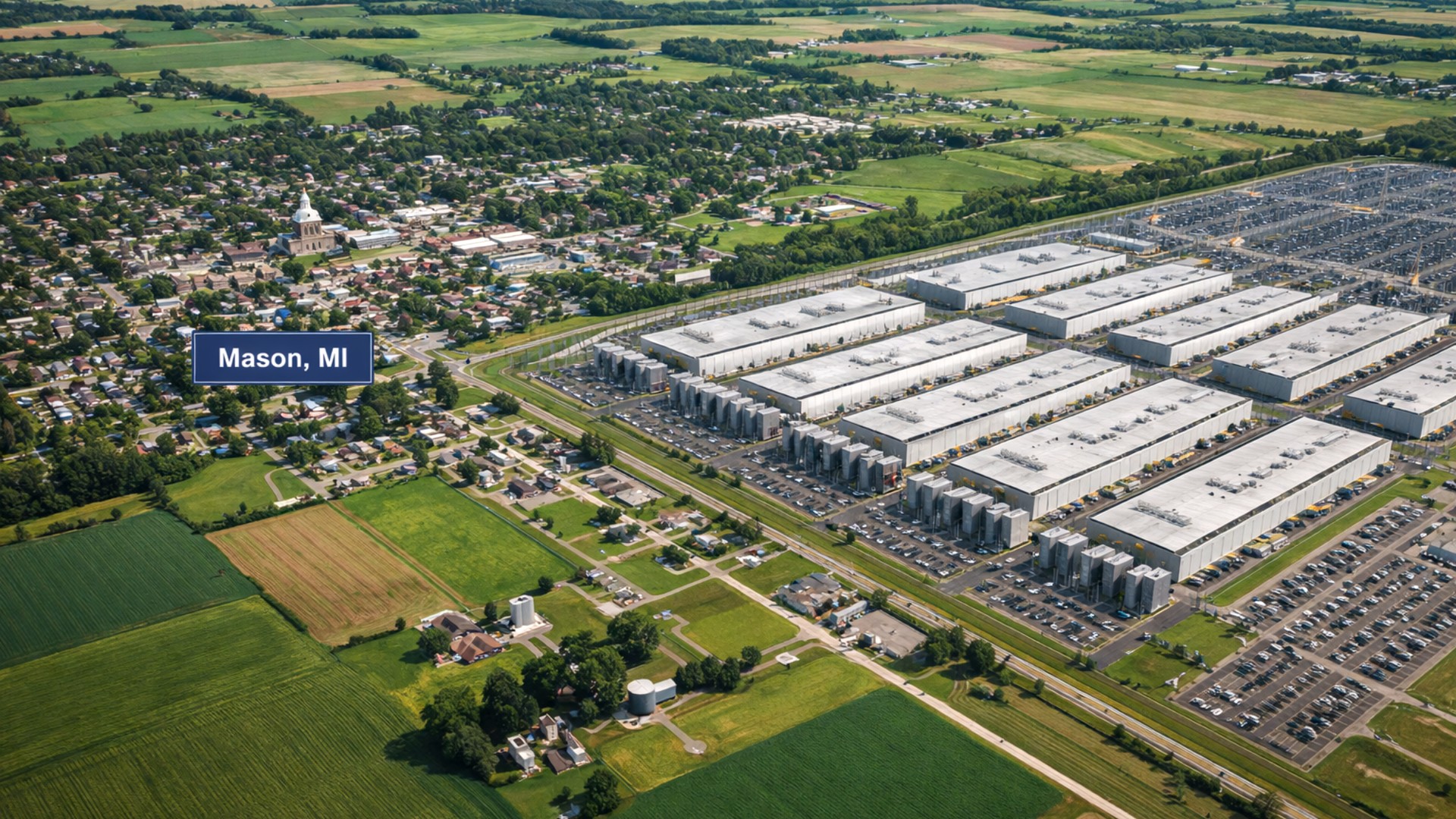
Mason, Michigan · Community advocacy
Mason’s future.
Get the data center facts.
Understand the proposed data center development, explore the public record, and help protect the place we call home.
A community milestone: City Council adopted Noise and Vibration Ordinance 272 on June 15, 2026. Read the background.
Mason’s story is reaching the nation.
NBC News reports on Mason’s data center debate. Watch the segment, then explore the local records and community concerns here.

Support the Defense Fund
Wear the Cause
Blue or gray. All sizes available to order, $30 each. Every shirt supports legal review, community outreach, and advocacy materials in the effort to protect Mason from data center development. Local pickup; new print runs are usually ready within 1–2 weeks.
Shop ShirtsThe Noise Ordinance
Adopted by City Council on June 15, 2026 as Ordinance 272. Now we’re watching for attempts to amend and weaken it.
Where it stands
Mason residents submitted more than enough verified signatures from registered City of Mason voters, and on June 15, 2026 City Council adopted the noise and vibration ordinance as Ordinance 272. That’s a real win — but it isn’t the end.
What we won
Ordinance 272 is now law. Mason finally has objective, enforceable property-line limits on continuous noise and vibration — the standards needed to evaluate a hyperscale data center before it’s built.
What we’re watching
The City attorney urged Council to adopt 272 and then immediately amend it — weakening the rules so a data center could sidestep them. If Council amends Ordinance 272, we are prepared to file a Referendum Petition and send those amendments to the November election for the people to approve.
That’s why your voice still matters: tell City Council to leave Ordinance 272 as adopted, and stay registered to vote in case any amendment goes to the ballot. Read the full update →
Mason long relied on subjective nuisance language to regulate noise. This community-drafted ordinance amends City Code Chapter 22, Sections 22-31 and 22-32 to add measurable sound and vibration limits — the kind of standards needed to evaluate hyperscale data center cooling systems before they’re built. Residents drafted it with their attorney, gathered verified signatures from registered City of Mason voters, and on June 15, 2026 City Council adopted it as Ordinance 272.
Where We Stand
How Mason got here — and what we’re working toward now.
Stronger Noise Rules
The ordinance amends Chapter 22 to add objective, measurable property-line sound and vibration limits. It was adopted June 15, 2026 as Ordinance 272 — and we’re ready to refer any amendment that weakens it to Mason voters.
See the OrdinanceFollow the Master Plan
Mason's Master Plan is the blueprint for our city's future land use. All new zoning districts and ordinances must align with it, and our elected officials must be held to that standard.
Learn MoreHow We Got Here
Mason residents drafted a stronger noise and vibration ordinance with their attorney, gathered verified signatures from registered City of Mason voters, submitted it to City Council on June 1, 2026, and on June 15, 2026 Council adopted it as Ordinance 272. The City attorney is now urging Council to amend and weaken it — and we’re prepared to refer any amendment to the voters.
The earlier fight set this up: Council adopted Ordinance 266 on February 2, 2026; residents gathered enough referendum signatures to put it on the ballot; and before that vote could happen, Council chose on their own to rescind Ordinance 266. For months afterward Mason had no enforceable noise and vibration standards for hyperscale data center development — until June 15, 2026, when Council adopted Ordinance 272. The fight now is keeping it intact.
- Feb 2, 2026 City Council passed Ordinance 266.
- Feb 16, 2026 Referendum petition succeeded — more than the required signatures.
- March 2026 Council rescinded Ordinance 266 themselves, before the referendum vote.
- Apr 22, 2026 Noise & vibration ordinance filed with attorney-approved language.
- May 2026 Residents gathered signatures from registered City of Mason voters.
- June 1, 2026 Petition submitted to City Council with verified signatures.
- June 15, 2026 City Council adopted the ordinance as Ordinance 272.
- Next Defend Ordinance 272 — referendum ready if Council amends it.
What You Can Do Right Now
Urge Council to keep Ordinance 272 as adopted, make sure you’re registered for November in case any amendment reaches the ballot, attend meetings, and help fund the legal and technical work behind stronger protections.
Why This Matters to You
The impacts of a hyperscale data center reach far beyond its property lines.
These aren’t ordinary data centers. Hyperscale campuses are industrial-scale facilities built in phases — large parcels, high lot coverage, tall buildings, major utility infrastructure, and 24/7 mechanical cooling to keep servers running. Their effects don’t stop at the fence line, which is why Mason needs measurable, enforceable standards before any future proposal advances.
Property Values
Industrial facilities near homes typically reduce nearby property values by 10–25%. The homes closest to a site tend to see the biggest drop.
Water Supply
Cooling can require millions of gallons of water a day — straining local aquifers and competing with residential wells, municipal water, and farms.
Power Grid & Rates
A single hyperscale facility can use as much electricity as 80,000 homes. Meeting that demand can strain the grid and push rates up for everyone.
Noise & Vibration
Cooling systems and backup generators run around the clock, producing constant noise and low-frequency hum audible for over a mile in a quiet rural setting. This is what the noise ordinance addresses.
Farmland Loss
Once farmland is converted to industrial use, it’s gone for good — along with the open space and rural character that define Mason.
Traffic & Roads
Construction brings heavy equipment and materials; even after opening, service vehicles, fuel deliveries, and worker traffic add ongoing road wear.
Tax Exemptions
Under Michigan Public Act 207 of 2024, enterprise data centers are exempt from sales and use taxes on equipment and construction — reducing state revenue that helps fund schools and services.
Heat & Environment
Data centers shed enormous waste heat and raise concerns about chemical coolants, electronic waste, and habitat loss on converted land.
Have a question that’s not covered here?
Contact UsThe Bigger Picture
The land, the tax breaks, and the power lines behind the data center pressure on Mason.
A stronger noise ordinance is the immediate step — but the pressure behind it is bigger. Specific parcels are under watch, state tax exemptions make Mason attractive to industrial developers, and new high-voltage transmission lines are being routed through the region. Here’s the wider context.
Proposed Development Areas
Properties of community concern for potential data center development.
The map below shows potential sites for data center development in the Mason area. These locations have not been officially confirmed, but are areas of interest based on available information. Use the research tools below to learn more.
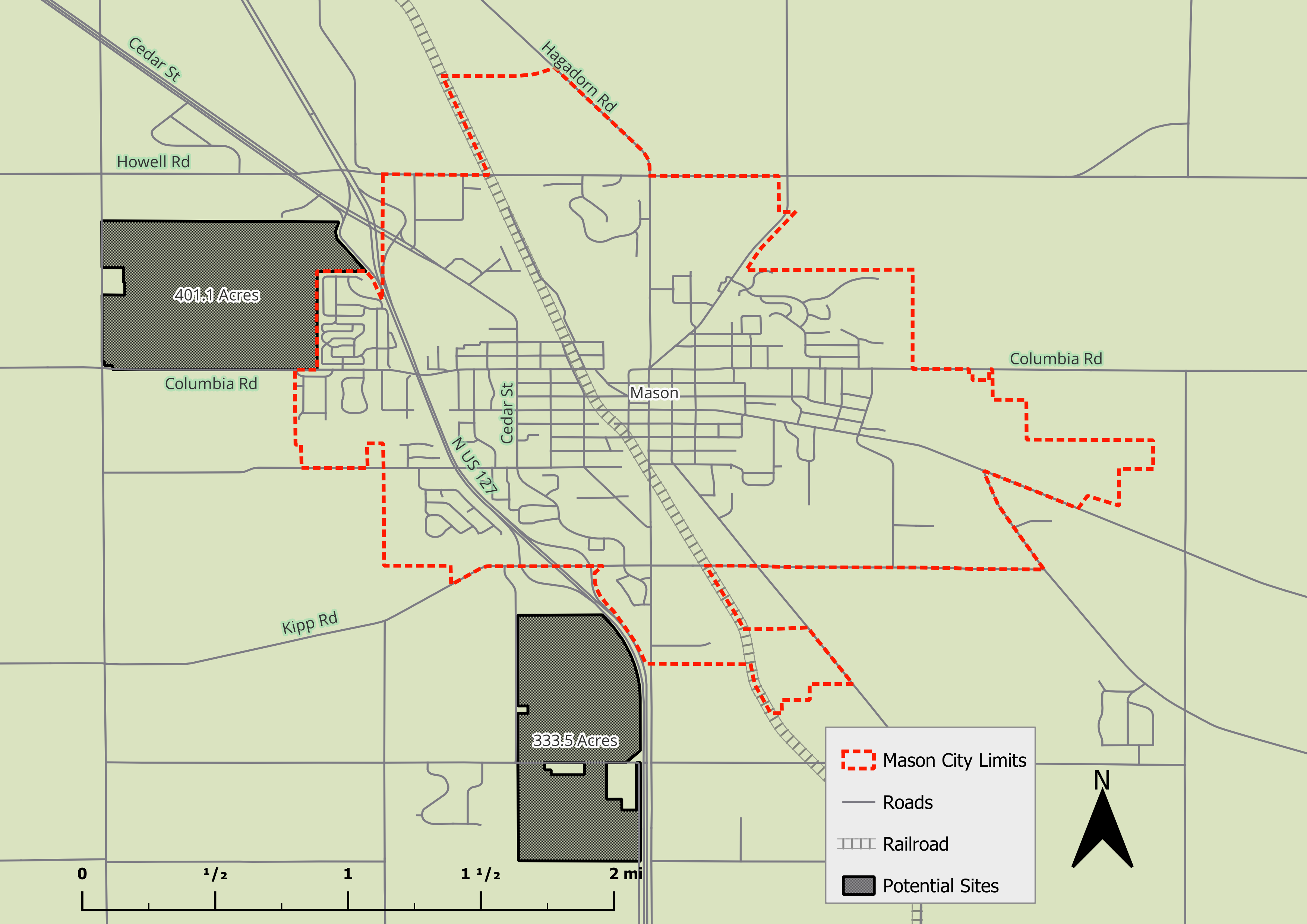
Potential data center sites in the Mason area. Locations are not confirmed.
Research Properties Yourself
You can look up property information, ownership records, and zoning details using these public resources:
BS&A Property Search
Look up parcels by address, owner name, or parcel ID. View tax records, assessed values, and property details.
Mason Master Plan
Review the city's comprehensive plan, future land use maps, and zoning information.
Ingham County GIS Maps
Interactive mapping tool showing parcel boundaries, aerial imagery, and property information.
Know Your Rights
If your property is adjacent to a proposed development site, you have the right to be notified of zoning changes and to speak at public hearings. Document everything and consider consulting with a land use attorney.
Michigan's Data Center Tax Breaks
Big tech gets massive exemptions. Local communities bear the cost.
In January 2025, Governor Whitmer signed Public Act 207, extending and expanding tax exemptions for "enterprise" data centers through 2050, and through 2065 for facilities on brownfield sites.
These exemptions eliminate Michigan's 6% sales and use tax on data center construction and equipment. The result? Corporations like Microsoft, Google, and Amazon can build massive industrial facilities while paying a fraction of what local businesses and homeowners contribute.
Employment does not scale with development. The 30-job minimum applies to any qualifying facility, no matter how large. A 100-acre, $1 billion data center is required to create the same minimum employment as a much smaller one — so a bigger industrial footprint does not mean proportionally more local jobs.
The Real Cost to Our Community
State Revenue Loss
The sales and use tax exemption reduces state revenue — including the share that feeds Michigan’s School Aid Fund. Local school operating millages (property taxes) are not affected by this exemption, but state-level support for Michigan schools and other services is.
Emergency Services
Fire, police, and EMS must be ready to respond to industrial emergencies. Who pays for specialized training and equipment? Local taxpayers.
Infrastructure
Roads, water systems, and electrical infrastructure need upgrades to serve data centers. These costs are often borne by municipalities, meaning you.
Electric Rates
In other states hosting data centers, residents have seen electricity bills increase as utilities upgrade infrastructure to meet massive power demands.
Learn More About the Legislation
Review the actual legislation and fiscal analysis:
ITC Transmission Lines
New high-voltage powerlines are being planned through our region, and data centers are a major driver.
ITC Holdings Corp. is planning to build approximately 95 miles of new 345-kilovolt transmission lines across Michigan, with an investment of nearly $850 million.
One of these projects, specifically the Oneida-Sabine Lake line, runs through Eaton, Ingham, and Livingston counties, directly in our region. These massive infrastructure projects are designed to support increased power demand, including from energy-hungry data centers.
The Data Center Connection
Hyperscale data centers require enormous amounts of electricity, often 100+ megawatts per facility. The existing power grid simply cannot handle this demand.
That's why new transmission infrastructure is being fast-tracked. While ITC frames these projects as improving "grid reliability," the timing aligns with Michigan's push to attract data center development through tax incentives.
The result? Rural landowners face potential property impacts to support industrial facilities that may pay little in local taxes.
Projects Affecting Our Region
Oneida-Sabine Lake Project
- Length: ~50 miles of new 345 kV lines
- Route: Oneida Township (Eaton Co.) to Sabine Lake (Livingston Co.)
- Counties: Eaton, Ingham, Livingston
- Status: Two preliminary routes proposed; MPSC to select final route
- Timeline: Construction unlikely before 2027
This line passes through northern Eaton County, southwest of Grand Ledge, and continues east through areas near Mason.
Nelson Road-Oneida Project
- Length: ~40 miles of new 345 kV lines
- Route: Oneida Township to New Haven Township
- Status: Part of MISO Long-Range Transmission Plan
Helix-Hiple Project
- Length: ~55 miles from Indiana to Michigan
- Route: Northern Indiana to Calhoun County
- Status: Michigan's first new interstate line in 50 years
Your Property Rights
If a transmission line is proposed near your property, you have rights. Here's what you need to know:
Don't Sign Without Legal Review
Option agreements allow companies to acquire property rights they would otherwise need to obtain through eminent domain. Have an attorney review any documents before signing.
Eminent Domain Protections
Michigan law requires transmission companies to prove their proposed route is "reasonably suitable and necessary." You can challenge this in court.
Just Compensation
You're entitled to fair market value, including impacts on remaining property. A farm bisected by a wide right-of-way suffers damages beyond just the easement area.
Attorney Fee Recovery
Michigan law (MCL 213.66) requires utilities to reimburse reasonable attorney fees if your compensation exceeds their initial offer.
Proposed Legislation: House Bill 4526
Rep. Jennifer Wortz (R-Quincy) introduced House Bill 4526 in the 2025 session to strengthen property owner protections in transmission-line eminent-domain cases:
- Eliminates automatic deference to MPSC route determinations in court
- Requires transmission companies to prove by clear and convincing evidence that their route is the most reasonable
- Prioritizes routes on public land, existing rights-of-way, and property boundaries
- Aims to limit interference with private property “as much as possible”
Status: referred to the House Energy Committee; as of public reporting, no hearing has been scheduled. Contact your state representative to express support for stronger property rights protections.
Stay Informed & Get Involved
MiFutureGrid.com
View interactive maps of proposed routes and project details
MI Public Service Commission
File comments and track regulatory proceedings
ITC Michigan
Company project information and community meeting schedules
Community Listening Sessions
ITC Michigan is holding public sessions to gather input on proposed routes. Check MiFutureGrid.com for dates and locations near you.
Take Action Now
Your voice matters. Here's how you can help protect Mason from industrial development.
Tell Council: Keep Ordinance 272 Strong
Ordinance 272 is now law — but the City attorney is urging Council to amend and weaken it. Email the Mayor and Council and ask them to leave Ordinance 272 as adopted. A short, respectful message from a resident carries real weight.
Upcoming Public Meetings
Attend Planning Commission and City Council meetings — especially when data centers, utilities, noise standards, or development agreements are on the agenda. Meetings are at Mason City Hall, 201 W. Ash Street, and are typically live-streamed on the City’s YouTube channel.
City Council
First and third Mondays at 6:30 p.m.
City Council controls ordinances, utility agreements, and final policy direction — including any amendments to Ordinance 272. Upcoming meetings: July 6, July 20, Aug 5 (Wed), Aug 17, 2026.
🏢 Mason City Hall · Agendas & videosPlanning Commission
Second Tuesday after the first Monday at 6:30 p.m.
Planning Commission is where special use permits, site plans, and land-use standards are reviewed. Confirm each month’s exact date on the City calendar before attending.
🏢 Mason City Hall (Sycamore Room) · Planning Commission pageHow to Speak at a Public Hearing
Never spoken at a city meeting before? Don't worry. Here's what to expect and how to prepare.
Arrive Early
Get there 15-20 minutes before the meeting starts. Sign up for public comment if required. Find a seat near the front.
Prepare Your Statement
Keep it to 2-3 minutes. Focus on how this affects you personally. Stick to facts. Write down key points so you don't forget.
Wait for Public Comment
The agenda will include time for public comment. When called, approach the podium. State your name and address for the record.
Speak Clearly & Respectfully
Address the council, not the audience. Be firm but polite. Personal stories are powerful. Thank them for their time.
💡 Tips for Effective Comments
- Mention specific concerns: water usage, noise, property values, traffic
- Share how long you've lived in Mason and why you chose this community
- Ask questions the council should answer at council meetings
- Advocate for community protections, special use review, and measurable standards
- Bring neighbors; numbers matter
Other Ways to Help
Contact Officials
Email or call the Mayor and City Council members. Ask them to keep Ordinance 272 as adopted — not weaken it — and to require enforceable standards for any data center development.
Find contact info →Spread the Word
Share this website with neighbors. Post on social media. Talk to friends and family in Mason.
Write a Letter
Submit a letter to the editor of local newspapers. Written opposition creates a public record.
Lansing State Journal, City PulseDonate
Help fund attorney review, technical analysis, and outreach materials. Every dollar supports the fight for stronger protections.
Contribute →Be Ready to Vote
If Council weakens Ordinance 272, we’ll refer it to the November 2026 ballot — and the same election decides local council seats. Make sure you’re registered and ready.
Check registration →Residents organized, gathered verified signatures, and on June 15, 2026 City Council adopted their noise and vibration ordinance as Ordinance 272. Now the City attorney is pushing to amend and weaken it. Tell Council to leave it as adopted — and help fund the attorney review and technical work to defend it and refer any amendment to the voters.
Legal Documents & Resources
Transparency matters. Access the official documents, filings, and research related to Mason's zoning decisions.
Zoning Ordinances
Official M-3 zoning ordinance documents and related city ordinances.
Meeting Minutes & Agendas
Records from City Council and Planning Commission meetings — available on the City’s official archive.
Legal Correspondence
Letters from attorneys and legal advisors regarding zoning matters.
Research and Educational Sources
Studies, educational explainers, and official reference documents (including the City's own handouts) to help residents verify claims and understand impacts.
🔍 How to File a FOIA Request
Michigan's Freedom of Information Act (FOIA) gives you the right to access public records. Here's how to request documents from the City of Mason:
- Write your request describing the records you want. Be specific about dates, topics, or document types.
- Submit to the City Clerk by mail, email, or in person at Mason City Hall.
- Pay any fees for copying and labor (the city will provide a cost estimate).
- Receive your documents within 5 business days (extensions possible for large requests).
City of Mason FOIA Coordinator
201 W. Ash Street, Mason, MI 48854
clerk@mason.mi.us
Disclaimer: Documents provided here are for informational purposes only and do not constitute legal advice. For legal questions regarding your specific situation, please consult with a qualified attorney. Some documents may be placeholders pending final versions.
Support Our Community
Your contribution helps protect Mason's future. Every dollar goes directly to our advocacy efforts.
Make a Contribution
Choose an amount to support our grassroots campaign against industrial data center development in Mason.
Your Information
Required for all donations under Michigan campaign-finance law.
Employer Information
Required for donations over $100 under Michigan campaign-finance law.
Secure payment powered by Stripe
About processing fees: Card processors charge a fee on every donation (2.9% + $0.30). So that your full intended gift reaches the campaign, that fee is added on top of the amount you select rather than deducted from it — a $50 donation is charged as $51.81, and the campaign receives $50.00. The itemized total is always shown before you confirm payment. Contributions are not tax-deductible.
Other Ways to Help
This Is a Grassroots Effort
We're not backed by corporate interests or political PACs. We're Mason residents who care about our community's future. Your support, whether $25 or $500, directly powers our ability to fight back against industrial development that threatens our way of life.
Make Your Voice Heard
Local elections shape our community's future. Make sure you're registered and ready to vote.
Check Your Voter Registration
Are you registered to vote in Mason? Verify your status, find your polling location, and view your sample ballot.
Check Registration StatusMichigan allows same-day voter registration at your local clerk's office.
🏢 Why Local Elections Matter
City Council and Planning Commission members make decisions that directly impact your daily life:
- Zoning decisions - like allowing industrial data centers in rural areas
- Property taxes - and who gets exemptions
- Infrastructure - roads, water, utilities
- Community character - what Mason looks and feels like
The people you elect will decide whether Mason stays rural or becomes industrial. Your vote matters.
Get in Touch
Have questions? Want to get involved? Reach out to us or contact your elected officials directly.
Contact Our Organization
Questions about this website, upcoming events, or how to help? We'd love to hear from you.
Email Us💬 Speaking to Officials? Here's What to Mention:
- Your name and address (proves you're a resident)
- How long you've lived in Mason
- Specific concerns: water, noise, property values, taxes
- Your support for special use review and objective noise/vibration standards
- Ask them to listen to the community before revisiting M-3 zoning
🏢 Contact Your Elected Officials
Let City Council know how you feel about M-3 zoning. Be respectful but firm.
Mayor & City Council
Mason City Hall, 201 W. Ash Street, Mason, MI 48854
City Staff
City Manager
Deborah Stuart, deborahs@mason.mi.us
Tip: Emails are public record. Send your concerns in writing to create a documented record of community opposition.